
Memorizing Code Doesn’t Make Anyone an Engineer
Exam-driven classrooms reward recall. Real engineering rewards understanding. When those two get confused, the cost isn’t just a lower score — it’s a generation of students who can reproduce a program perfectly and still not know where to start on a new one.
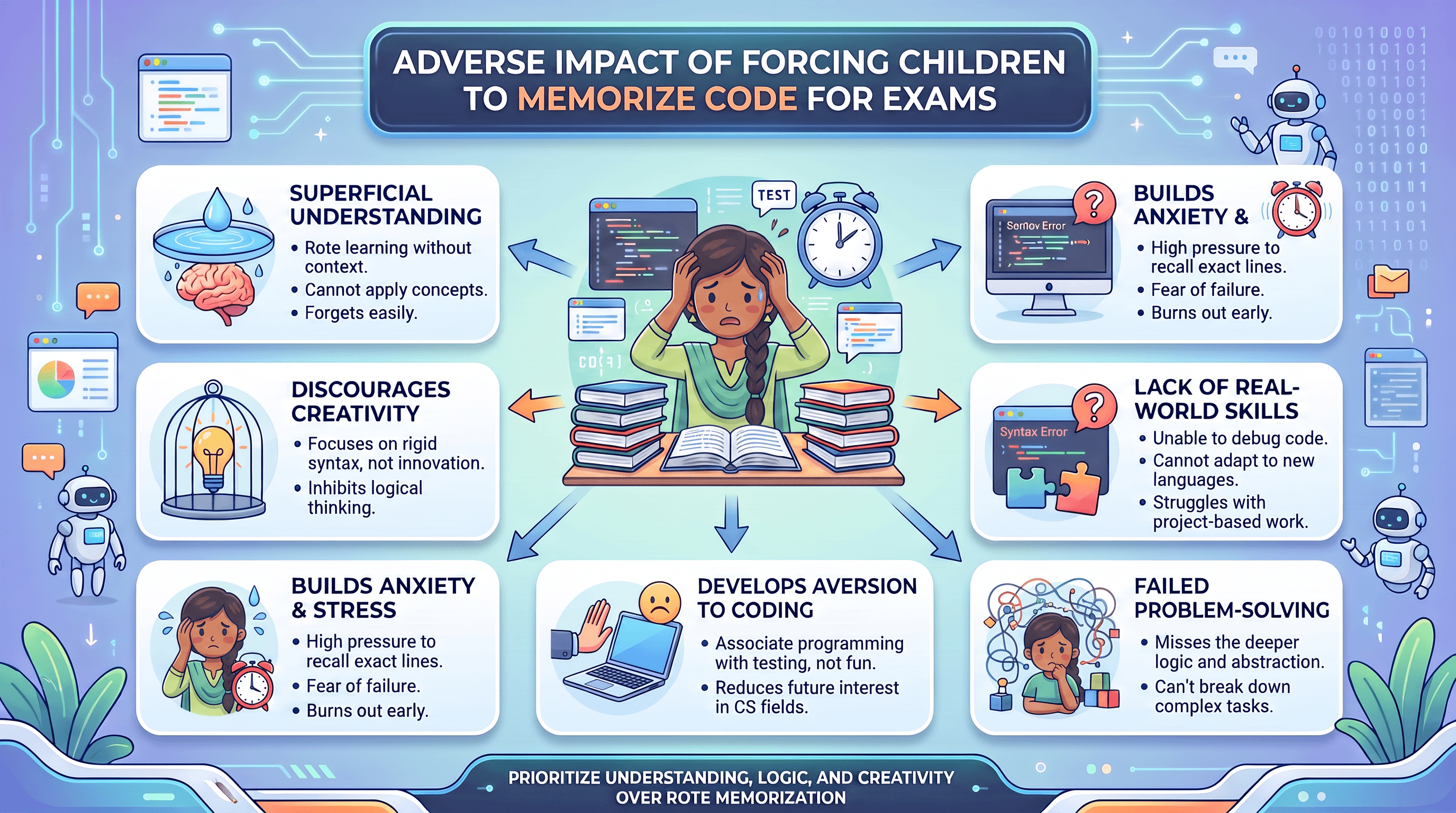
Six failure modes, one root cause: a classroom that measures recall instead of understanding.
What gets weaker when recall replaces reasoning
Students learn what to type rather than why it works — weakening logical reasoning, problem-solving, algorithmic thinking, and creativity. A student who memorises a sorting program may reproduce it perfectly on the exam, then freeze the moment it needs to be modified.
Recall-based confidence only works on familiar questions. Slightly modified problems, real-world scenarios, or unseen challenges trigger anxiety — the quiet realization of “I know the program, but I don’t know how to start.”
Programming is a skill, like chess or mathematics — it is built by experimenting, making mistakes, debugging, and exploring alternatives. Pure memorisation skips every one of those steps.
High marks feel like success, but that confidence rests on repeated exam patterns and familiar code samples. Change the environment, and it disappears just as quickly as it arrived.
Young minds naturally ask "why does this work?" and "is there a better way?" When exams reward only recall, that curiosity is gradually replaced by exam-oriented learning.
The professional cost shows up years later
Students who equate programming with memorising syntax often conclude it is difficult, boring, or not for them — and steer away from software, data science, AI, and engineering. Ironically, real development rarely requires memorising large amounts of code.
Professional developers spend far more time solving problems, designing systems, reading documentation, and collaborating than memorising syntax. Rote-trained students can walk away thinking "I’m bad at programming because I can’t memorise everything" — when the profession never asked them to.
Employers look for logical thinking, adaptability, communication, and the ability to learn new technologies. Code memorised today can be obsolete within a few years — memorisation alone doesn’t transfer.
Students who repeatedly struggle with memorisation-heavy exams can start to believe they aren’t suited to technology or innovation — and choose careers based on exam performance and familiarity rather than genuine interest or talent.
Innovation comes from understanding systems, questioning assumptions, and building new solutions. A culture centred on memorisation tends to produce workers who follow instructions well, but struggle to innovate or lead change.
The fix is a ratio, not a ban
Basic syntax, common patterns, frequently used functions, and core formulas are fine to memorise — they’re the alphabet, not the essay. The problem begins when memorisation becomes the primary learning strategy instead of a supplement to it.
Instead of asking students to reproduce code from memory, exams can move closer to what the job actually looks like:
- Debugging existing code
- Explaining program logic
- Designing algorithms
- Solving real-world problems
- Open-book coding exercises
- Project-based assessments
The strongest minds don’t remember the most code.
They understand how to build solutions they’ve never seen before.
More from Real Engineer Insights →REAL ENGINEER · REALENGINEER.IN